Choosing the best Dynamic Gas Dilution System in 2026 depends on the work it must perform, not just its advertised precision. A system used to prepare calibration gases for an analyzer has different demands from one supporting research across a broad concentration range. Flow accuracy, dilution range, gas compatibility, and long-term stability all deserve careful review.
Look closely at the hardware. Mass flow controllers should suit the intended flows, while fittings and wetted materials must match the gases in use. Check how the system handles zero gas, source-cylinder changes, and routine leak checks. Clear software, readable flow displays, and accessible service parts can make daily operation more dependable. Small details count.
Specifications alone can mislead. Ask for calibration documentation, stated uncertainty, and test conditions behind performance claims. Compare independent verification where available, and confirm that the system can be maintained by qualified technicians. Also consider installation space, required utilities, training, and future expansion. A low purchase price may not mean lower ownership costs.
There is no universal winner. The strongest choice is the one whose verified performance matches the application and whose support remains practical after installation. That judgment takes work. Even a well-matched system may need careful setup, periodic checks, and operator training. This guide examines the criteria that matter, common trade-offs, and questions buyers can ask before selecting a system for 2026.
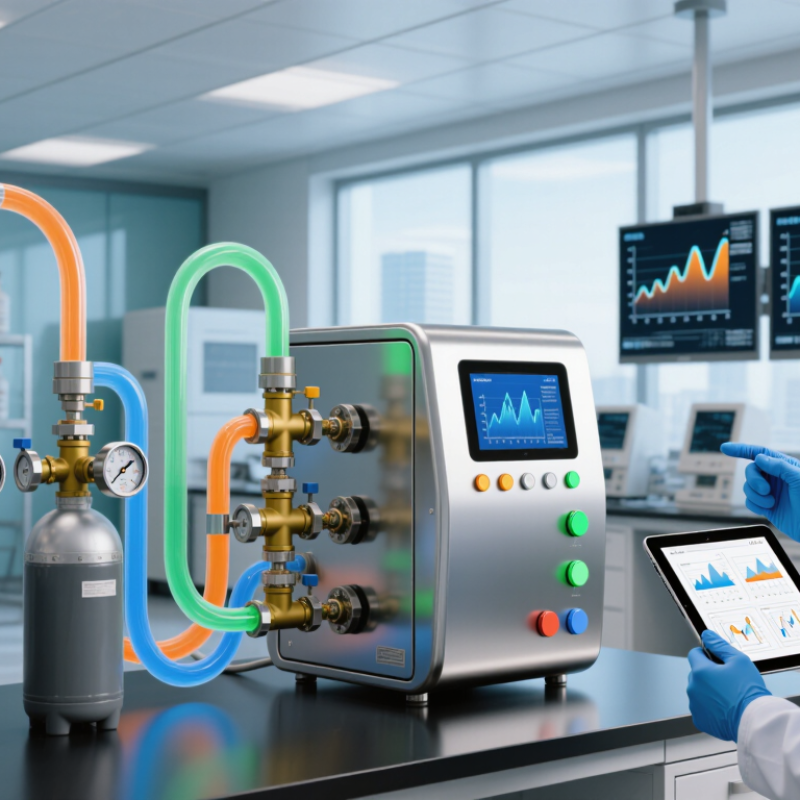
Dynamic Gas Dilution Systems: Principles and the ISO 6145-7 MFC Method
What Is the Best Dynamic Gas Dilution System in 2026?
Dynamic Gas Dilution Systems: Principles and the ISO 6145-7 MFC Method
The best system depends on the target concentration, required uncertainty, and gas properties. Dynamic dilution blends a concentrated source gas with a balance gas at controlled flow rates. For ideal mixing, the output concentration equals the source concentration multiplied by its molar flow, divided by the combined molar flow. Small details matter. Flow readings must use compatible reference conditions, and the gas mixture needs enough time and space to mix.
ISO 6145-7 describes preparing calibration gas mixtures with thermal mass-flow controllers. Each controller sets a flow, and the flow ratio establishes the dilution. For example, reducing the source-gas flow while holding the balance-gas flow steady lowers the output concentration. The method is flexible, but accuracy depends on controller calibration, gas-specific response, pressure stability, and the flows selected. A controller operating near its lower limit may contribute greater uncertainty.
A careful evaluation should check the usable flow range, repeatability, materials in contact with the gas, and how uncertainty is calculated. Confirm that calibration data apply to the gases and operating conditions in use. ISO 6145-7 provides a preparation method, not a blanket guarantee of performance. Even a well-designed setup can drift; documenting checks and watching for changes in flow behavior are practical safeguards. No single configuration is best for every laboratory.
Key Components: Mass-Flow Controllers, Gas Sources, and Mixing Manifolds
In 2026, the best dynamic gas dilution system depends on its intended flow range and required stability. Mass-flow controllers (MFCs) regulate each stream, so select ranges that keep routine settings away from their lower limits. An oversized controller may struggle to hold a very small flow. Check materials for gas compatibility, and confirm calibration with the actual gas or an appropriate correction factor. Small details matter. Log zero checks, calibration dates, and response times under operating conditions; a specification sheet cannot capture every installation issue.
Gas sources need steady pressure and clean connections, since pressure changes can affect controller performance. Use suitable regulators, leak-check fittings, and document source conditions during testing. The mixing manifold should combine streams evenly before the outlet, with enough residence length for the gases to blend. Dead spaces and long, narrow tubing can delay response or retain traces from a previous setting. Measure the outlet mixture with an independent analyzer when accuracy matters. It is tempting to assume a well-designed manifold solves every mixing problem, but flow, tubing, and setup all matter. Compare measured results with the target, and adjust the design when they disagree.
Dilution Ratio in Practice: 1% to 1 ppm Requires a 1:10,000 Dilution
A 1% gas mixture contains 10,000 ppm of the target component. Reaching 1 ppm therefore requires a 10,000-fold dilution: one part stock gas in 10,000 parts final mixture. The arithmetic is simple. Stable delivery is not.
A practical setup can use two 100:1 stages, reducing 1% to 100 ppm, then 100 ppm to 1 ppm. Each stage needs suitable flow ranges and careful verification. ISO 6145-7:2018 describes dynamic gas-mixture preparation with thermal mass-flow controllers, a relevant method for this work.
Flow settings alone do not prove the outlet concentration. Check controller calibration, pressure stability, mixing, and the system’s response after changing concentration. At 1 ppm, small flow errors or surface interactions can matter; the exact effect depends on the gas and equipment.
The U.S. EPA’s 2012 Traceability Protocol for gaseous calibration standards and NIST Technical Note 1297 both address measurement traceability and uncertainty. Their practical lesson is to document the uncertainty budget, not just the setpoints.
On paper, clean. In a real manifold, less so. A staged 1:10,000 dilution is useful only when each stage is verified and the final reading is allowed to stabilize.
How to Compare 2026 Systems: Flow Range, Accuracy, and Calibration Traceability
The best dynamic gas dilution system in 2026 is the one that fits your actual operating range, not simply the one with the widest specification. Compare the minimum and maximum flows for each gas, then check whether the system can hold stable output at your typical setpoints. A wide range can look impressive, but performance near the low-flow limit may matter more in daily work. Ask for measured data at representative flows, not only headline specifications.
Accuracy needs context. Check whether stated uncertainty applies to each flow controller, the final diluted concentration, or both. Also review how temperature, pressure, gas properties, and mixing time affect results. For example, a laboratory preparing low-concentration calibration mixtures may need steady output after each setpoint change. Observe the system’s settling behavior with your own test method. The published figure may not tell the whole story.
Calibration traceability should be documented and practical to maintain. Review certificates for the reference standards, calibration dates, stated uncertainty, and measurement range. Check whether the calibration chain reaches recognized national or international standards. Check the certificate. Confirm how often recalibration is recommended and whether service records are easy to retain. In practice, documentation can be overlooked when a system is busy; that is an imperfect habit worth correcting. A careful comparison should weigh usable flow range, verified accuracy, and traceable calibration together.
Comparing Dynamic Gas Dilution: Ideal Concentration vs. Flow Ratio
These calculated values show how the standard-gas-to-diluent flow ratio determines the ideal outlet concentration. They illustrate dilution behavior, not the measured performance of any particular system.
Calculation: outlet concentration = source concentration × standard-gas flow ÷ (standard-gas flow + diluent flow), assuming compatible flow reference conditions and ideal mixing. When comparing systems, check usable flow ranges, stated flow accuracy, and calibration traceability; actual uncertainty depends on the system and its calibration.
Choosing a System for Gas Type, Target Concentration, and Application
The best dynamic gas dilution system in 2026 is the one that matches your gas, target concentration, and working conditions. Start with the gas. Confirm that wetted materials suit its chemistry, especially if it is corrosive, reactive, or moisture-sensitive. Then check the required concentration range and total flow. A system designed for high flows may struggle to control very small additions accurately.
For low target concentrations, examine the diluter’s specified range, measurement uncertainty, and flow-controller performance. Ask how accuracy was verified and whether calibration records are available. Your application matters, too: a laboratory calibration bench may need stable, repeatable output, while process testing may require quick adjustments and reliable operation across changing flows. Consider response time, outlet pressure, temperature, and humidity. Small details can shift results.
Tips: Match the flow range to your actual operating points, not just the maximum listed. Verify performance at the lowest concentration you plan to use.
Before choosing, request test data for conditions close to yours. A certificate alone may not show how the system behaves with your gas mixture or at your target flow. Plan routine checks, and confirm that replacement parts and technical support are available. One easy-to-miss issue is how the outlet connects to your instrument; tubing and dead volume can affect response. I would not assume a system is suitable based on its headline accuracy alone. Test it in the setup where it will actually be used.
Conclusion
A Dynamic Gas Dilution System produces carefully controlled gas mixtures by combining a source gas with a dilution gas at measured flow rates. In systems based on the ISO 6145-7 mass-flow-controller method, calibrated controllers regulate each stream, while gas supplies and a mixing manifold help create a consistent output. Understanding the flow settings and dilution ratio is essential: reducing a 1% concentration to 1 ppm requires an overall dilution of 1:10,000.
When comparing systems in 2026, consider their usable flow range, measurement accuracy, stability, and calibration traceability. The right choice depends on the gas type, required target concentration, and intended application. A system should support the desired dilution range while maintaining reliable control and producing mixtures suitable for the measurement or testing task. Matching these capabilities to practical requirements is more useful than choosing solely by a headline specification.

 Airppb