7 Tips for Choosing a Dynamic Gas Distribution Device

Time:2026-11-22 Author:Ethan
0%

Choosing a Dynamic Gas Distribution Device is not just a matter of comparing catalog prices. The right unit must deliver stable, repeatable gas flow under your actual operating conditions. A mismatch can cause uneven process results, wasted gas, or frequent adjustments. Small details matter.

Start with the gases involved, required flow range, inlet pressure, and target accuracy. Check whether wetted materials suit the gas and cleaning routine. A clear display may help operators, but it cannot compensate for poor sizing. Ask how the device behaves during startup, flow changes, and interruptions. These moments often reveal issues that a steady-state specification does not.

Also consider installation space, connection types, control interfaces, calibration options, and service access. Picture the device mounted in your system: Can a technician reach the fittings? Are readings easy to verify? Can replacement parts be obtained without a long delay? Request performance data for conditions close to your own, and confirm what the manufacturer’s stated accuracy includes. Not every datasheet makes this obvious.

There is no perfect choice on paper. Real systems can be untidy, and a device that works well in one setup may disappoint in another. A short trial, when practical, can expose assumptions before they become costly. The seven tips that follow provide a structured way to compare options, ask better questions, and choose a Dynamic Gas Distribution Device that fits both the process and the people maintaining it. Begin with evidence, not a feature count.
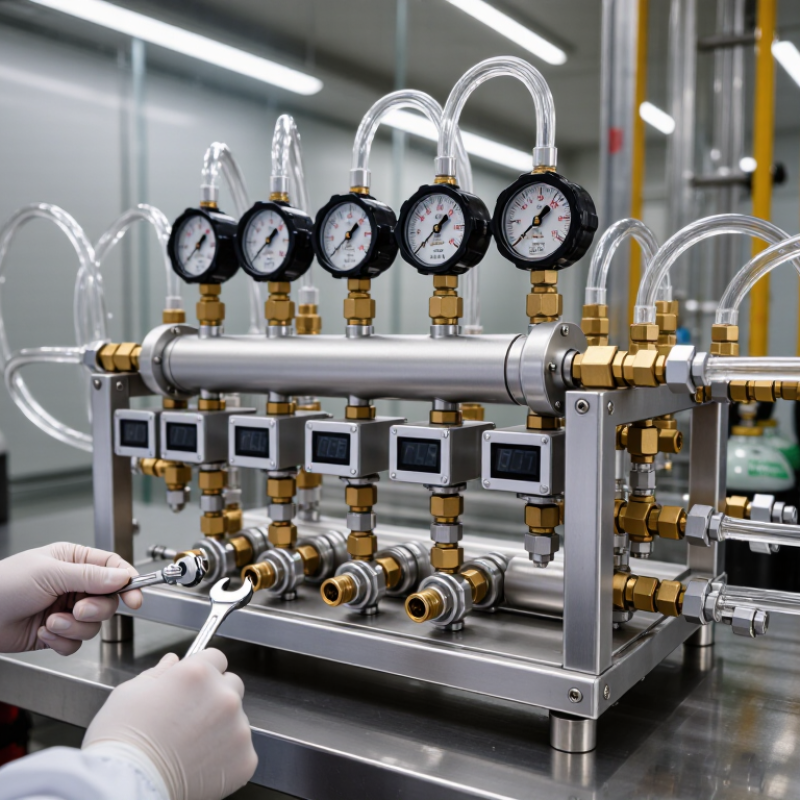
7 Tips for Choosing a Dynamic Gas Distribution Device

Define the Mixing Method: Mass-Flow Control Under ISO 6145-7

Under ISO 6145-7, thermal mass-flow controllers generate a gas mixture by regulating each component’s flow. The method is useful when concentrations must change quickly or be repeated across a test series. Set the component flows, verify the total flow, and allow the outlet line to stabilize before sampling. Small errors matter. A controller’s displayed setpoint is not proof of the delivered composition; calibration, gas properties, and operating pressure all affect the result.

The WMO Greenhouse Gas Bulletin No. 20 reported a global average carbon dioxide concentration of 420.0 ppm in 2023, an increase of 2.3 ppm from 2022. That scale of change shows why dependable reference mixtures matter in atmospheric measurement.

For a practical setup, record controller calibration status, gas identity, pressure, temperature, and flow settings with each run. Check the blend at the point of use when the application requires tighter confidence. I still treat low-flow operation cautiously. Even a stable-looking reading can hide drift, and tubing dead volume may delay the mixture reaching the analyzer. ISO 6145-7 gives the framework; careful verification makes the method credible.

Match Flow Capacity to Demand in sccm, slpm, or Nm³/h

When choosing a dynamic gas distribution device, begin with measured demand, not the largest value on a process sheet. Record each branch’s normal flow, peak flow, and how often peaks occur. A short purge can change the total quickly. Note it. Include all branches that may run at the same time, rather than adding every branch’s maximum automatically.

Keep flow units consistent. Sccm means standard cubic centimeters per minute; slpm means standard liters per minute. With matching reference conditions, 1,000 sccm equals 1 slpm. Nm³/h expresses normalized cubic meters per hour; 1 Nm³/h equals about 16.67 normalized liters per minute. Check the stated reference temperature and pressure before converting. “Standard” and “normal” conditions can differ between specifications, so a neat conversion may still be misleading.

Choose a device whose usable range covers both routine flow and credible peaks. A unit sized only for peak demand may control poorly at low flow, while a small unit can restrict delivery during simultaneous use. For example, compare the lowest steady demand with the device’s minimum controllable flow, not just its maximum rating. Leave sensible headroom, then verify performance at actual inlet pressure and gas conditions. This estimate is only a starting point; real demand can be less tidy than the spreadsheet.

Match Flow Capacity to Demand

Example peak-flow requirements and device full-scale capacities. All chart values are in slpm.

These examples use a 20% capacity margin above peak demand as a starting point, not a universal sizing rule. Confirm the device’s accuracy and usable operating range at your actual flow. Unit conversions: 1 slpm = 1,000 sccm; on a 0°C, 101.325 kPa reference basis, 1 Nm³/h ≈ 16.667 slpm.

Check Gas Compatibility Using ISO 10156 Flammability Classification

Before connecting a dynamic gas distribution device, identify every gas and its concentration range. ISO 10156 provides methods for assessing the flammability and oxidizing ability of gases and gas mixtures. Use the classification to flag combinations that may change the system’s hazard profile. A cylinder label alone may not describe a blend across its full operating range. Check the current safety data sheet and gas certificate. Small details matter. Confirm that the documents match the actual supply, not an earlier formulation.

Then compare the classification with the device’s operating conditions, including pressure, flow, and purge sequence. Verify wetted materials, seals, regulators, and sensors against each gas; a suitable classification does not prove material compatibility. For a changing mixture, assess the most demanding concentration and transition conditions, not only the steady-state recipe. In practice, documentation can be incomplete, and that uncertainty deserves a pause. Ask the gas supplier or a qualified safety professional to clarify ambiguous composition data. Record the review and revisit it whenever the recipe or hardware changes. A brief check can prevent an overlooked incompatibility.

Compare Accuracy and Repeatability Using % of Reading and % of Full Scale

Tip 1: Compare the error basis, not just the percentage. A device rated at ±1% of full scale across a 0–100 sccm range may deviate by up to 1 sccm. At a 10 sccm setpoint, that is a large share of the target. By contrast, ±1% of reading at 10 sccm equals ±0.1 sccm. Small flows expose the difference.

Tip 2: Check how repeatability is reported. Accuracy describes closeness to a reference value; repeatability describes how closely repeated measurements agree under the same conditions. A device can repeat a reading consistently while remaining offset from the true flow. Ask whether repeatability is expressed as a percentage of reading or full scale, and request the test conditions. Details matter.

Tip 3: Match the specification to your actual operating range. Compare both figures near your lowest and typical flow settings, not only at maximum capacity. Also verify the stated gas, pressure, temperature, and calibration conditions. For example, repeated runs at 10 sccm may look stable, yet a full-scale-based tolerance could still be too wide. The awkward part: specification sheets do not always make the comparison easy. Double-check the definitions before selecting a device.

Verify Pressure Ratings in bar and Calibration by ISO/IEC 17025 Labs

Tip 1

Check the device’s rated pressure in bar, not just the expected line pressure. Confirm whether the rating refers to maximum operating pressure or a short-duration limit. Leave room for pressure spikes during valve changes. Also check the rating at your actual operating temperature; materials and seals can behave differently as temperatures shift. Small details matter.

Tip 2

Match the pressure range to the job. A sensor rated far above your normal pressure may provide less useful resolution. For a dynamic gas distribution device, compare inlet pressure with expected outlet pressure and flow. Look for pressure-drop data at realistic flow rates. A specification measured under different conditions may not predict your setup well. This is easy to overlook.

Tip 3

Request a current calibration certificate from a laboratory accredited to ISO/IEC 17025 for the relevant measurement scope. Check the instrument’s serial number, calibration date, pressure range, reported uncertainty, and traceability details. The certificate should cover the range you actually use, not merely the device’s full scale. Keep the document with maintenance records, then schedule recalibration based on usage, stability, and your quality procedures. A certificate alone is not a substitute for checking the device in service.

FAQS

How does mass-flow mixing work under ISO 6145-7?

Thermal mass-flow controllers regulate each gas component separately. Their combined flows create the target mixture.

What should I check before collecting a sample?

Set each flow, verify total flow, and let the outlet line stabilize. Small errors matter.

Does a displayed flow setpoint confirm the delivered gas concentration?

No. Calibration, gas properties, and operating pressure can affect the delivered composition.

What details should I record for each mixing run?

Record gas identity, calibration status, pressure, temperature, and flow settings. Keep the notes with the run.

Why can tubing delay a mixture reaching the analyzer?

Dead volume in the tubing can hold older gas. Allow time for the new mixture to reach the sampling point.

How should I check a device’s pressure rating?

Confirm whether its rating is for maximum operating pressure or a short-duration limit. Check the rating at your operating temperature, too.

What should I look for in a calibration certificate?

Check the instrument serial number, calibration date, pressure range, uncertainty, and traceability. The certificate should cover your working range.

Is a calibration certificate enough to confirm reliable operation?

No. Check the device in service and plan recalibration based on use and stability. I may be overly cautious, but low-flow readings can drift.

Conclusion

Choosing a Dynamic Gas Distribution Device begins with understanding how the gases will be blended. For mass-flow control, confirm that the intended mixing approach aligns with the principles of ISO 6145-7 and that the equipment can maintain the required proportions across expected operating conditions. Next, match its flow capacity to actual demand, whether specified in sccm, slpm, or Nm³/h, and check that the available range provides enough flexibility without sacrificing control at typical flow rates.

Assess gas compatibility using the relevant ISO 10156 flammability classification, and compare performance specifications carefully: accuracy and repeatability may be stated as a percentage of reading or a percentage of full scale, which can affect how results are interpreted. Finally, verify pressure ratings against the system’s operating requirements and review the calibration documentation. Calibration by an ISO/IEC 17025-accredited laboratory can help support confidence in measurement traceability and device performance.


Ethan

Ethan

Ethan is a seasoned marketing professional with a deep expertise in our company's innovative product line. With a passion for sharing knowledge and insights, he takes the lead in regularly updating our corporate blog, where he explores industry trends, product features, and effective marketing......